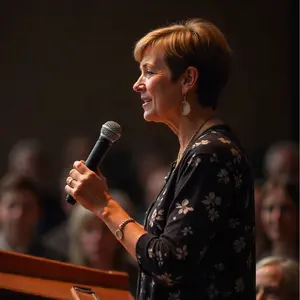
outputGenerated with EulogyAI using AI
Family and friends, thank you for being here today to honour the life of Amelia Grace O’Connor — Millie to so many of us.
We gather with heavy hearts,
and we gather with deep gratitude.
Gratitude for a life so full of purpose and quiet courage,
for the kindness she turned into action,
and for the way she made the ordinary feel cared for and complete.
I stand here as Millie’s childhood neighbour and closest friend for over thirty years.
We learned our streets and our summers side by side in Hobart,
grew into adulthood on parallel paths,
and kept the sort of friendship that could go silent for a week and then resume with a knowing smile and a plan.
She was born on 5 January 1984 and left us this February, aged forty-two.
Too soon for us;
but long enough for her to leave a clear and generous imprint on everyone she met.
Millie’s beginnings were simple and strong.
Siobhan and Patrick built a home where warmth had habits:
cups of tea were offered before coats came off,
and being on time was a form of respect.
Her brother Declan will tell you — as only a brother can — that she was organised from the outset.
Her school notes were labelled, her pencil case immaculate,
yet she saved her mischief for timing.
A raised eyebrow,
a perfectly placed remark,
a dry joke that arrived like a gentle tap on the shoulder.
Never a performance,
always a nudge toward the lighter side.
At the University of Tasmania she chose nursing, not as an idea, but as a direction of travel.
She knew where she wanted to spend her hours:
with people,
at the bedside,
doing the small things well because they make the big things bearable.
After graduation she moved to Melbourne to join the Royal Children’s Hospital,
and there she grew into the nurse so many families relied on —
the one whose hands were steady,
whose words were measured,
and whose humour surfaced just when a parent needed to exhale.
There are nurses who excel in clinical skill,
and there are nurses who carry families through the darkest hours.
Millie did both.
She advocated for her patients with a calm persistence that earned respect long before she raised her voice — which she rarely did.
She would prepare a medication chart as if it were a personal promise.
She asked the extra question during handover.
She made sure the night-shift parent knew where the spare blankets were,
and that the morning coffee somehow appeared at the time it was most needed.
If integrity has a sound,
it might be the soft click of a chart closed properly,
or the gentle tone of a nurse explaining,
once more,
what the plan is and why it matters.
Her service didn’t clock off at the ward exit.
Millie volunteered in the community,
fundraised for children’s health services,
and was always the first to show up with a raffle book or a tray of lamingtons still warm at the centre.
Her lamingtons, by the way, were the sort you remember —
light sponge, proper chocolate,
coconut that did not fall away at the first touch.
She baked because it gathered people,
and because it tasted like care.
Outside of work, Millie kept her balance in ways that were characteristically grounded.
She loved bushwalking.
Tracks around kunanyi/Mt Wellington were her first routes,
but she never said no to a new path,
a map folded at the right page,
a thermos tucked in beside the snacks.
There was that famous camping trip at Cradle Mountain,
where the rain came sideways and stayed for three days.
Tents sagged. Tempers nearly did.
Millie, soaked through and cheerfully unfazed,
brewed the perfect billy tea under a makeshift tarp,
handed around mugs with a grin,
and asked who wanted seconds before anyone had a chance to shiver.
She kept everyone smiling,
not by pretending the weather was fine,
but by making the moment hospitable.
That was her gift —
to turn a hard day into a day you can handle.
She loved words as much as walks.
Crosswords were done in pen only — a statement, not a dare.
Her text messages were small masterclasses in timing:
“Thinking of you — eat something green today”
or
“Parking out the front. Breathe.”
They would land at just the right moment,
as if she had an extra sense for when a person needed one steady sentence.
Millie sang in a community choir,
never seeking the solo,
always keeping the harmony.
It seems fitting that today’s service includes her favourite hymn.
Music — like good nursing, like good friendship —
finds its strength in listening.
The centre of her life was her family.
To Daniel, the beloved partner she chose and chose again,
she brought that same steadiness and spark.
They formed a home made of lists on the fridge and laughter in the kitchen,
where plans were clear and jokes were dry,
and dinner could be both nutritious and second-helpings.
To Ruby and Finn, her adored children,
she was a calm morning and a sure hand.
She made school projects feel possible,
bandaged knees with mastery,
and read stories with a voice that could settle a whole room.
She taught you to pack your bag the night before,
to say please and thank you without fuss,
to look for the person on the edge and make space beside you.
These are not small lessons.
They are a way of walking through the world.
And they are now yours to carry.
To Siobhan and Patrick,
you gave Millie a blueprint of care that she followed with honour.
To Declan,
she was your sister and your compass.
She loved you fiercely and quietly,
the way she loved everything that mattered.
Colleagues from the Royal Children’s Hospital have spoken of her with a tenderness that tells its own story.
They will miss her competence,
and they will miss the way she made competence feel kind.
Families will remember her soothing voice,
the practical tips scribbled on a note,
the way she could make a night in intensive care feel slightly less infinite.
Her friends will miss the simple miracles —
a lift to the airport at dawn,
a cake left on a doorstep, still warm,
a message that said “I’m outside — no need to talk, just getting some air with you.”
What defined Millie were not grand gestures,
but a thousand reliable acts.
She was compassionate without fanfare,
organised without rigidity,
and quietly determined.
If a path needed clearing,
she would roll up her sleeves and begin,
starting with what was right in front of her,
showing the rest of us how progress is usually made:
by attention,
by consistency,
by turning up when you say you will.
Today we feel the shape of her absence in so many ways.
We will miss her soothing voice.
We will miss those thoughtful texts that arrived like a hand on the shoulder.
We will miss her steady, practical care —
the sense that, if Millie was around, the essentials were already being looked after.
And yet, even as we say goodbye,
her influence remains here, concrete and ongoing.
It lives in the habits she cultivated:
the bag packed the night before,
the slice wrapped for a neighbour,
the quick walk taken because fresh air resets the mind.
It lives in the values she held:
kindness in action,
integrity as a practice,
and the quiet power of doing the small things well.
For those who loved her most, grief will come in waves.
There will be mornings when the house is too quiet,
and evenings when the phone should light up and doesn’t.
There will also be moments — often unexpected — when Millie feels close:
a hymn sung softly,
the smell of coconut and chocolate,
the sight of a crossword finished with confident pen strokes.
Let those moments arrive.
They are not tricks of memory;
they are the ways love continues its work.
In the days ahead, we will watch a slideshow of Millie’s life,
and we will see what we already know:
that she moved through the world with purpose and gentleness,
that her smile often began in her eyes,
and that she made spaces warmer just by entering them.
May those images remind us not only of what we have lost,
but of what we have been given.
It is fitting, in keeping with Millie’s nature,
that in lieu of flowers the family asks for donations to the Royal Children’s Hospital.
She would have approved,
not as a symbol, but as a practical good.
If you wish to honour her today,
please consider doing so in that way —
a gift that will help the very children and families she devoted her life to.
To Daniel,
to Ruby and Finn,
to Siobhan and Patrick,
to Declan,
and to all who loved Millie:
may you feel held by the community she helped to knit together.
We cannot lessen the weight you carry,
but we can shoulder it with you.
And we can promise that Ruby and Finn will grow up surrounded by stories that sound like her —
steadfast,
funny at just the right moment,
firm about what matters.
Millie once told me, after a long shift and a longer tram ride home,
that she believed in “leaving things a fraction better than you found them.”
A patient’s room,
a roster,
a friendship,
a Tuesday.
If each of us did even a portion of that each day,
the world would tilt, gently, toward the good.
That is the legacy she leaves us:
not a monument,
but a method.
So let us remember her by the way we make tea for the person beside us.
By the way we turn up five minutes early.
By the way we speak softly when softness is what’s needed,
and clearly when clarity will help.
By the way we take a walk even when the weather is uncooperative,
and find, under some makeshift shelter,
that the billy tea still tastes perfect.
Millie, dear friend,
thank you for thirty years of companionship that never needed noise to be certain.
Thank you for the laughs that arrived on time,
for the counsel that was accurate and kind,
and for proving, again and again,
that care is not a feeling but a practice.
We will carry your example into our homes, our work, and our streets.
We will keep an eye out for each other.
We will finish the crossword,
bake the cake,
make the call,
and do the small things well.
May you rest in peace,
and may your gentle, steady way continue in us.
We are better for having known you.
And we will make sure that, wherever we go from here,
things are, in your honour,
a fraction better than we found them.